Examples of our work
Recent projects:
The Piece Hall, Halifax
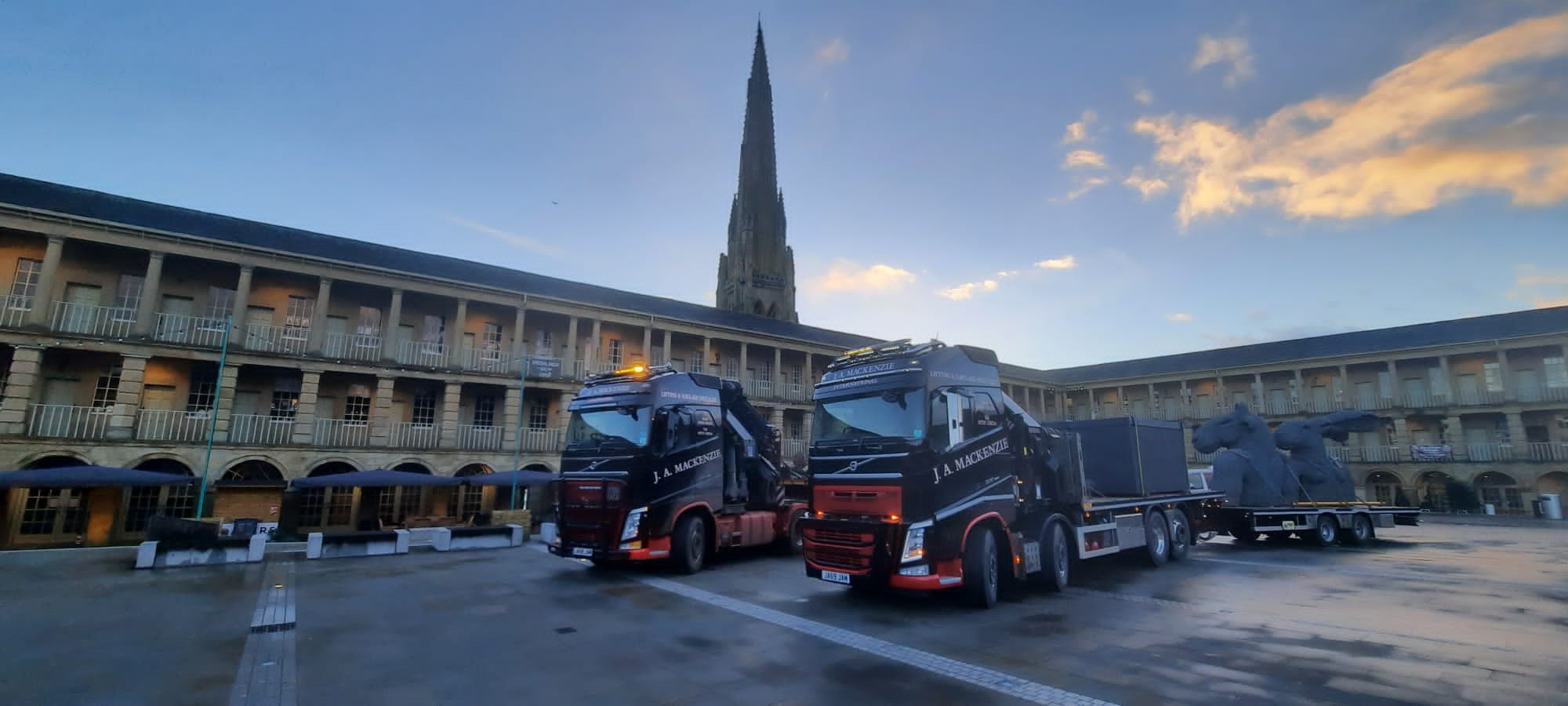
This February we were lucky to be part of a huge installation of Sculptures at The Piece Hall, Halifax. The courtyard hosts a UK first with a selection of sculptures by world renowned artist Sophie Ryder. The six pieces installed included the 4.5m high ‘Dancing Hares’, which has never been exhibited publicly in the UK before, and the sculptures were positioned by ourselves using our specialist equipment and operatives across the 66,000 sq ft courtyard. On display until 23 May 2023 where they can be viewed by the public free of charge.
Sophie Ryder’s work and sculptures are inspired by animals and mystical creatures and have been exhibited globally in Canada, the U.S.A. Germany and Sweden, alongside major exhibitions at Yorkshire Sculpture Park. The exhibition at the Piece Hall includes: Dancing Hares (bronze); The Minotaur and The Hare on Bench (bronze); Torsos (Lady Hare and Minotaur) (galvanised steel wire); Crawling (bronze); Girl with Knees Up (bronze); Ladyhare on Boar on a Barrel.
We have been lucky enough to be part of the installation team, installing many of Sophie Ryders’ sculptures throughout the UK and abroad and in that time, we have become good friends. We admire Sophie’s attention to detail, passion and her dedication to her art is phenomenal. The Piece Hall was an exciting opportunity for our small specialist team to work together for a whole day, as often we are spread far and wide. The outcome was magnificent, and we have so many great photos from the day we wish we could share them all!
With thanks to The Piece Hall and Ellis Robinson for the short film.


The Secret Spitfire Salisbury
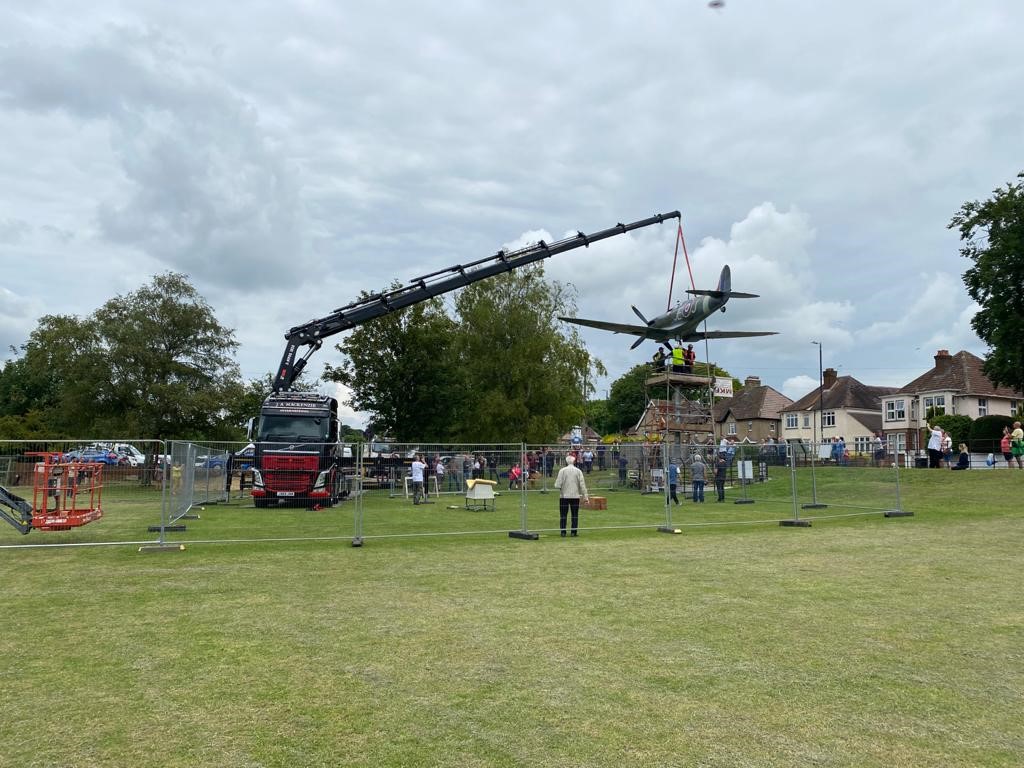
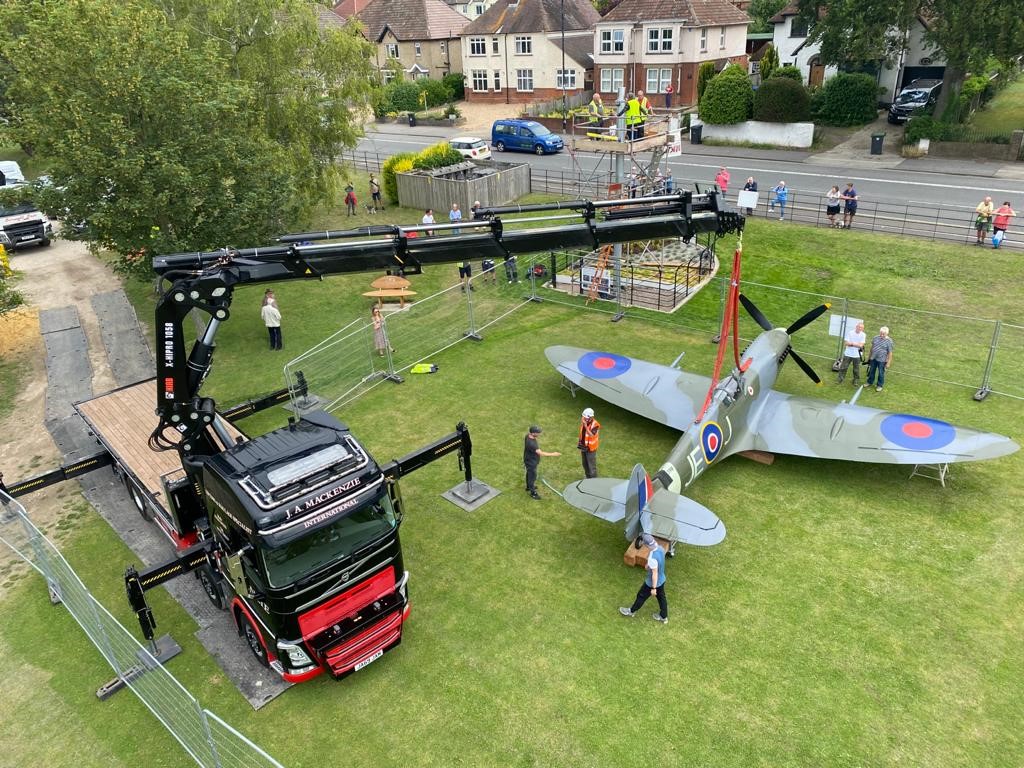
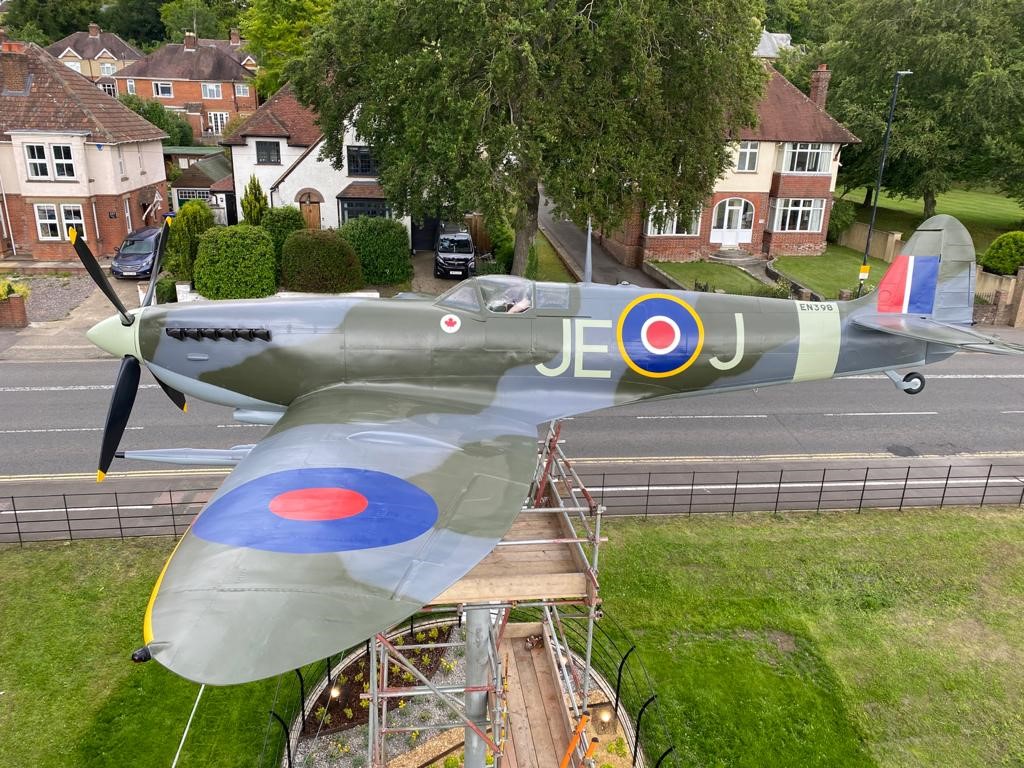
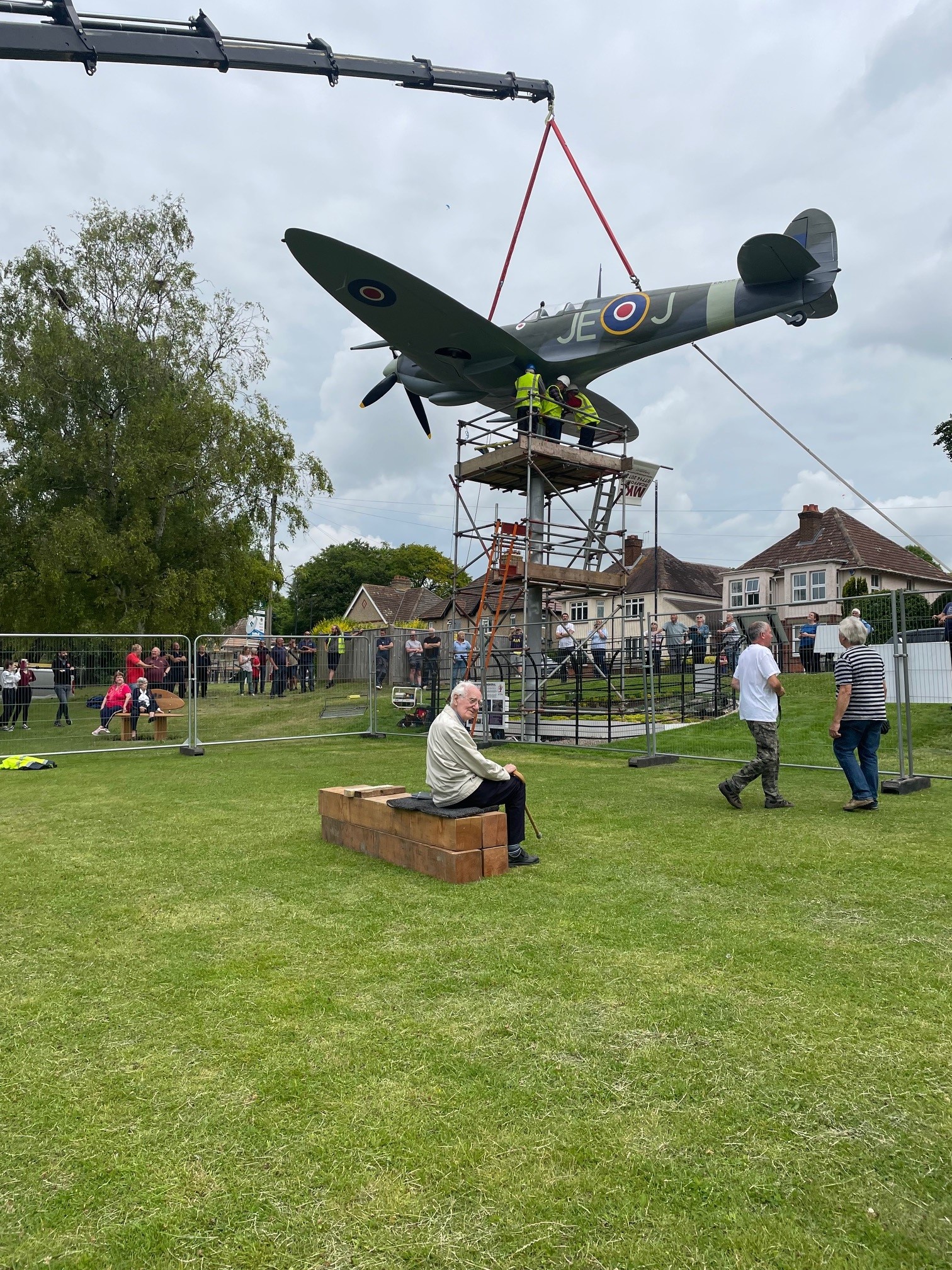 I was approached regarding the safe haulage and installation of The Secret Spitfire at the beginning of 2020. The project appealed to me on many levels, the rich history and symbolism of the Spitfire as well as the prevalent connections to my home town of Salisbury. We collected the piece in Norfolk where it was constructed, however due to the pandemic the installation was delayed by a year.
Spitfires were the instrument in which put a halt to Hitler’s plans for invasion. In 1940, many of the Spitfire factories situated in Southampton were destroyed by the Germans. Many of the factories relocated to secret locations and more rural parts, one being Salisbury. The monument recognises the residents who were part of the engineering and construction process of the fast fighter/interceptor MK-9 Spitfire aircraft in secret – in their homes, sheds, a bus depot and a hotel – to help defend Britain during the Second World War.
The monument took two days to install and was a great success. We are so proud to have been part of this magnificent landmark.
To find out more about The Secret Spitfire Charity and the story behind this monument please follow this link: https://www.secretspitfires.com/
Messenger – Plymouth Theatre Royal
When I was approached by Castle Fine Arts about 3 and a half years ago to move Bianca (“The Messenger”) it seemed quite a simple task; transport it in 4 pieces, put it together at Plymouth in the car park opposite and then lift into place – how wrong can you be about the biggest bronze sculpture in the UK?!
 It started off with 3 days in North Wales at the Foundry putting the sculpture together, finding the centre of gravity etc. Two 65 ton HIABS and a 50 ton mobile crane were used and a lot of lifting gear, not to mention the head scratching with the confined space that we had.
To transport the piece to the build-up site took 2 of our low loaders, boom lift, and a lot of kit from our stores. The build-up area was a secret location in the Naval Base so access and security was fun for the next 2 weeks.
The re-building of the Messenger took 5 days, again with 2 HIABS and an 80 ton crane. Once the sculpture was in one piece, however, it looked stunning.
Then came the installation. I arrived at Plymouth on the 16 March and checked everything was in place for the next few days activities….
 Sunday 17th March – St Patricks Day
One 100 ton crane and one King’s low loader. It took me two hours to rig the sculpture using the boom lift but I finally got the Messenger to lift perfectly onto the low loader and strapped down for transport – 400 metres to where the sculpture would be lifted onto a 50m x 14m barge. The barge itself can carry over 1000 tonnes.
The 10 ton sculpture was lifted from the low loader onto the front centre of the barge using the 100 ton mobile crane. It was then strapped and welded to the deck for the voyage at 0330hrs the next morning. We finished at 1800hrs on that first day and celebrated with a well-earned pint of Guinness.
 Monday 18 March – Installation Day
The whole city of Plymouth had a vibe of excitement about it. For me personally this involved a lot of anticipation, and not a great deal of sleep – just wanting to make sure that I had everything in place.
The barge set sail on time and the weather was being very kind to us. We placed 20 tons of matting at the ferry terminal to set up the 100 ton mobile crane which was needed to lift the sculpture from the ferry terminal onto the ;low loader. I couldn’t believe how many people (or press!) were at the terminal and also on a boat that was hired in to track and film the journey on the barge.
At 0730hrs Messenger arrived and the sculpture was lifted onto the low loader, and then strapped for the final journey of about a mile; 8 metres tall and 5 metres wide – this took a 4 police escort vehicles and bikes to get through.
I made my way to the Theatre Royal Plymouth for the final lift with an 80 ton mobile crane, where more matting was needed.
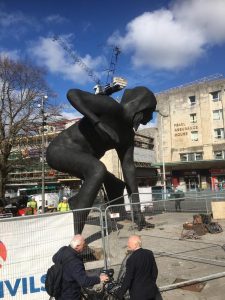 By now the streets were lined with people and children from local schools who had made the journey to watch this historic event taking place.
We were all ready at the Theatre Royal and the first police car emerged from Union Street – people were cheering and hanging out of windows, it was a great sight to see and an amazing atmosphere to be part of.
With the road now closed for the lift it was all hands on deck to get the sculpture form the truck to the final position.
Everything went according to plan and timings were perfect. The afternoon was less hectic – I used some 1 ton weights to hold the sculpture in place until the morning.
A well-deserved beer and buffet was in order at the local pub with Chris Butler and Chris Jones from Castle Fine Arts, Joseph Hillier, the sculptor and Hugh Borthwick from the Theatre Royal, plus a good pat on the back for everyone involved.
My thanks go to South West Crane Hire and King’s Heavy Haulage for their part in this momentous project with the lifting and heavy haulage.
This is one I will never forget.
Gift Wrapped CHP System into Tight Space within London Hotel
Shentongroup Video: Gift Wrapped CHP System into Tight Space within London Hotel
This video sees shentongroup deliver a gift-wrapped Combined Heat and Power System (CHP) into a tight space within a prestigious London hotel.
More here: http://www.shentongroup.co.uk/products/power-therm/
Posted by shentongroup on Wednesday, 27 September 2017
Roni Horn, Invercauld Estate, October 2017
 Following a flight to Aberdeen to carry out a site visit in mid July, it was apparent that this was going to be an extraordinary (if not, rather challenging) project; 5 tonnes of solid glass to be installed into the grounds of a huge Castle. We had no idea at this point where it was going to go.
The installation was due to take place mid October and we were advised that it was not until the sculptor arrived then, that we would know where the sculpture was to be placed.
I had seen a place in the mature woods that would have been great – but that would take us through a stream and two large fields “please no!” – that would be so much work, and heart stopping moments.
We arrived at the Castle two days after the sculptor, as arranged, and yes – it had to be – the sculpture was to go in the mature woods across the stream (and yes – through the fields!).
We prepared for the worst case scenario and started laying the matting – all 12 tons of it, and we had the 6 ton telehandler which was going to be a complete necessity. The timbers we had brought with us were so big, two men were needed to carry them – and we had all the lifting gear we could get on the truck. 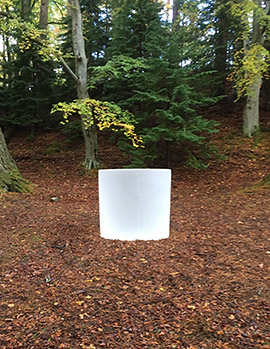
The sculpture had to be kept 8° either side of 17° so it was insulated with blankets and sheeted for the journey.
The track and the ground work was completed within a day and the lifting process went according to plan. We used every last piece of that lifting gear too!
The precision needed to land this sculpture was phenomenal and Rob completed the job perfectly.
Finally, after months of preparation and planning, Roni Horn had her sculpture in the mature woods, across the stream, and through the fields (!) at the breath taking Invercauld Castle in the Highlands of Scotland. Most will wonder how it even got there in the first place……
But of course, that is what we do.
The sculpture itself has a surreal glow around it which fits with the mature surroundings.
I complete many installations year in and year out – but this is definitely one I will never forget.
My sincere thanks goes to Roni Horn for allowing us to use the images shown here.
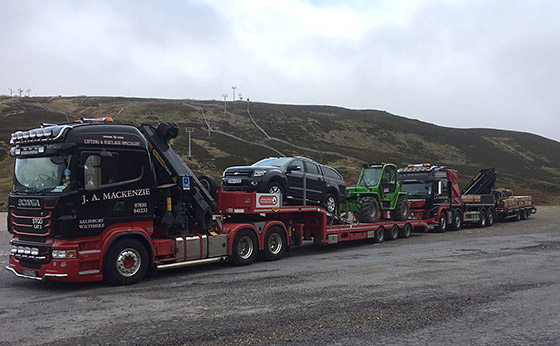
Building the Sculpture by the Lakes stand at Chelsea Flower Show 2015
Doll’s Head To Norway
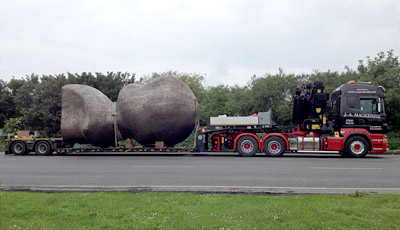
When Chris at Castle Fine Arts approached me a couple of years ago and said “I have a job in Norway I would like you to do”, I thought he was thinking ahead. And he was, a 7 tonne bronze doll’s head; 7 metres tall, 4.2 metres wide, and, even when laid down, 3.9 metres high. This caused a lot of head scratching (pardon the pun) for a while, until I could work it out, bit by bit.
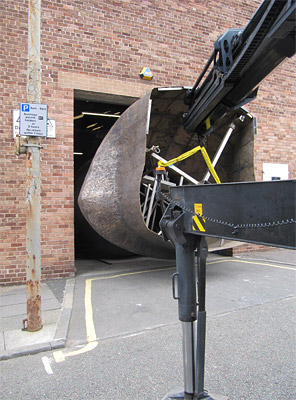
The first challenge was to get the sculpture out of the building; wit only 50mm each side, and next to no room overhead – this in itself would be no mean feat. We used sheets of ply and oil in order to edge the piece out of the building to be lifted onto the low loader. I should add that all the time this was going on I was being filmed for a television documentary…. no pressure then!
The next part of the journey meant a police escort down through the UK to the port at Immingham, at 4.2 metres wide, the same high and 20 metres long – this was quite a sight. The journey would take 27 hours.
Due the sheer size of the load, Norwegian road regulations meant I could only travel at night, with two pilot cars and police escort. In Oslo we had to run the length of the tramways, as these were the only roads big enough to take the large load.
We finally reached our destination in Oslo at 02:00am, and I had the next day to organise the lifting, and try to get some sleep before we set about getting the load off. We used an 80 tonne crane and the crane on my Scania to upright the sculpture and place it on the pre cast concrete pad.
That evening, Chris and myself had a well deserved beer and celebrated a job well done.
The job took nine days from start to finish and I would like to thank Convoi Exceptionnel in Southampton and John Hudson Trailers for all their assistance with this job, as well as Chris Butler at Castle Fine Arts.
Helaine Blumenfeld – Salisbury Cathedral and Park Lane, London
 Helaine Blumenfeld is a sculptor I admire so much, still working hard and attending every installation of her work. Helaine spends most of her time between Italy and the UK. Her work is mainly marble or bronze, both large and small – and believe me very awkward to move!
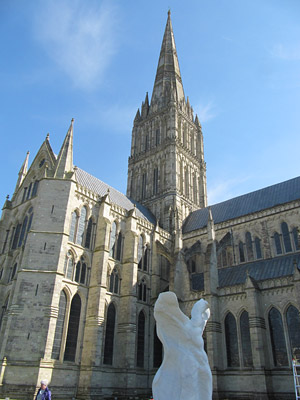
I first worked for Helaine back in 2000 moving sculptures from London and Cambridge, but when I learnt that all of Helaine’s work was going to be exhibited at Salisbury Cathedral I was thrilled that we were asked to do the installation. On closer examination of the manifest – I realised what a mammoth task was ahead…
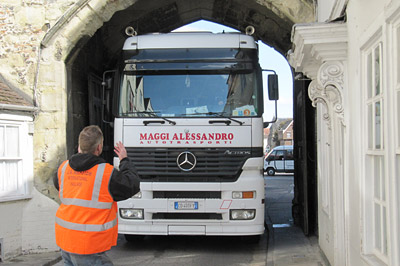
Esprit and Mysteries had to come from Italy. Cleopatra, Space Within and Flight were to come from Cambridge, and the list went on. All the sculptures had to get through a 3.9 metre high arch at Salisbury Cathedral. Flight had to be carefully laid down – and so began the sleepless nights! Once started, the weights of the marble sculptures; more than 7 tonnes, were carefully strapped, choked and placed in and around the Cathedral. Five long, hard days resulted in the cathedral having more visitors than ever before, and, in my opinion, the best exhibition of sculpture to be staged in Salisbury for a very long time.
 Then, just when my sleeping patterns had returned to normal(!) the phone rang with the next task for Helaine; to move “Spirit of Life”.This piece had never been moved on its base before and so a travel crate had to be made that was going to be strong and robust enough to take such a heavy lift.
The location of the sculpture was the next problem; set in the heart of the forest at Cass Sculpture Park in Goodwood – with undulating ground all around meant getting a lorry crane in would be difficult, but moving the piece even more so because of how the ground was laid around the piece. Getting the ground level and stable took 16 tonnes of timber, mats and blocks.
The top of the sculpture was, as is a regular feature of Helaine’s pieces, extremely fragile and we had to have straps specially made to do the job. Once out of the woods and onto an ultra low loader trailer, it was off to Park Lane at 05:30am on a Sunday morning to carry out the installation. Using a 70 ton crane, this part was relatively easy – although the road had to be closed as is often the case for installations of this size. As always, Helaine was there to oversee the installation, and so too were the BBC to film this beautiful masterpiece being installed.
To this day we are still working on new projects and installations for Helaine and the Bowman Gallery in London. I have to say, that despite the challenging nature of handling Helaine’s sculptures – they are magnificent works of art and look fantastic in any setting.
A lot of people were involved in Helaine’s installations and I would like to thank them all, not least Keara and her team in Italy. Here’s to the next movement for Helaine…..
For more photos of these installations – please go to the Photo Gallery.

Waddesdon Manor
One of the many beautiful homes owned by Lord Rothschild. In 2012 it saw its historical gardens turned into a sculpture park, with some of the largest pieces in the UK and Europe on display for 5 months throughout the summer.
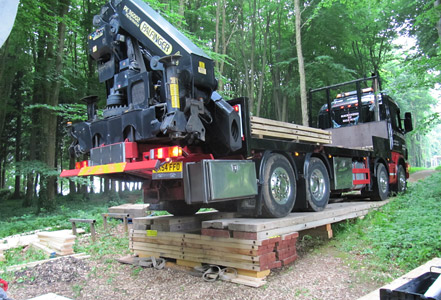
We were called upon for our lifting expertise having the heavy cranes required to take on the transportation and installation of most of the larger sculptures.
One crate, at 3.9 metres high, gave us some head scratching moments as Waddesdon Manor is situated between two 15ft bridges – making transporting anything a major operation. At 3.2 metres wide on a low trailer we had just 40mm to spare. Once on site I had sculptures coming in from all over Europe and the UK, six working days to complete the installation. Our large crane with fly jib covered most of this work with its 25 metre reach, (the heaviest sculpture was 5 tonnes) – meaning that much of the lifting itself was relatively easy.
One of the heaviest sculptures came from France and took 15 tonnes of heavy matting to protect the grass, 3 lifting devices (2 HIABs and one tele-handler), and two very keen French men to erect the piece. With the help of RDM Transport Limited and our experienced staff, all the pieces were installed safely, and on time. So that was the job done, for the Summer anyway…. November saw the de-installation of the exhibition and the work began all over again…..
Pegasus and the Paratrooper
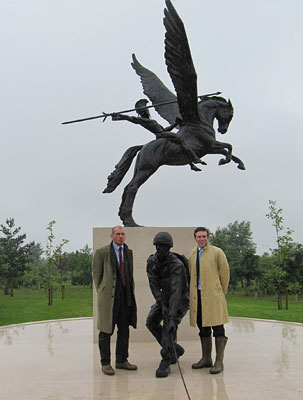
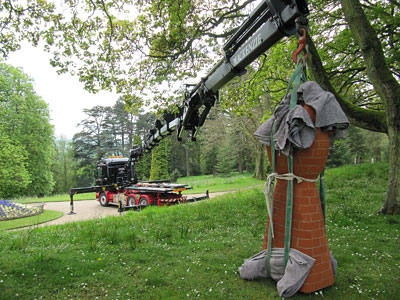
 Mark Jackson and Charlie Langton are masters of their craft. This job involved the placement of two outstanding pieces of sculpture, serving as a Memorial to the Parachute Regiment and Airborne Forces.
This was a difficult move to say the least; the height of the Pegasus sculpture was the first issue – however, with our expertise we decided that rotating the Pegasus through 30 degrees and having a bespoke transportation frame made solved that. Over hanging branches and low trees were another problem – but thanks to Ginger Farrar (an old friend of Mark’s) we managed to clear a 10 mile section of the route through mid Wales to see our way clear to our destination.
So much thought and preparation had gone into the project before we had even started – what could possibly go wrong! Added to the pressure was the timescale – a huge event had been arranged for the unveiling of these pieces due to be attended by HRH Prince Charles – these pieces had to go in on time.
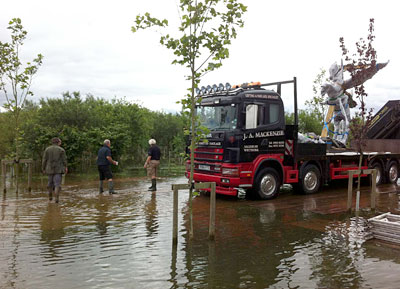
June and July saw some of the worst rainfall in the UK for decades. The National Arboretum near Litchfield was in the thick of it. It was under 18 inches of water – with torrents running through the park on the day we arrived. The night before the installation was due to take place, the whole thing looked hopeless. The sculptor, Mark ‘Jacko’ Jackson sat on a post overlooking the park, which by now resembled a lake – the job, for him, was cancelled.
 At J A Mackenzie we don’t give up so easily. I sat with my driver, Rob Langley, that night and formulated a plan – we were as confident as you could be that we could get those pieces where they were supposed to go. The next day we met the team bright and early in the car park – the only place that wasn’t under two feet of water – and told them our plan.
We transferred the sculptures onto a smaller truck and proceeded with care through the narrow single track roads under water, a man at each corner to guide the truck through – one wrong move at this stage could mean the soft verges giving way – and the truck would be turned over – sculpture and all!
Rob drove the truck with the care and precision he always does – and after holding our breath quite a bit, we arrived at the installation site.
We needed sixteen tonnes of heavy 5m x 1m matting in order to stabilise the crane and keep it in position whilst we unloaded the sculptures. We had given up on keeping dry by now – even the carp swimming between our legs were eager to come and have a look at what was going on….!
With the help of Jacko’s fantastic team of men, Rob and I worked a long and hard day to get the final result; a magnificent tribute to the Airborne Forces to whom we owe so much.
N.B. No fish were injured during this installation.
For more photos of the installation at Litchfield – please go to the Photo Gallery.